e

How to adjust the clutch release drive of the "VOLGA GAZ 21".
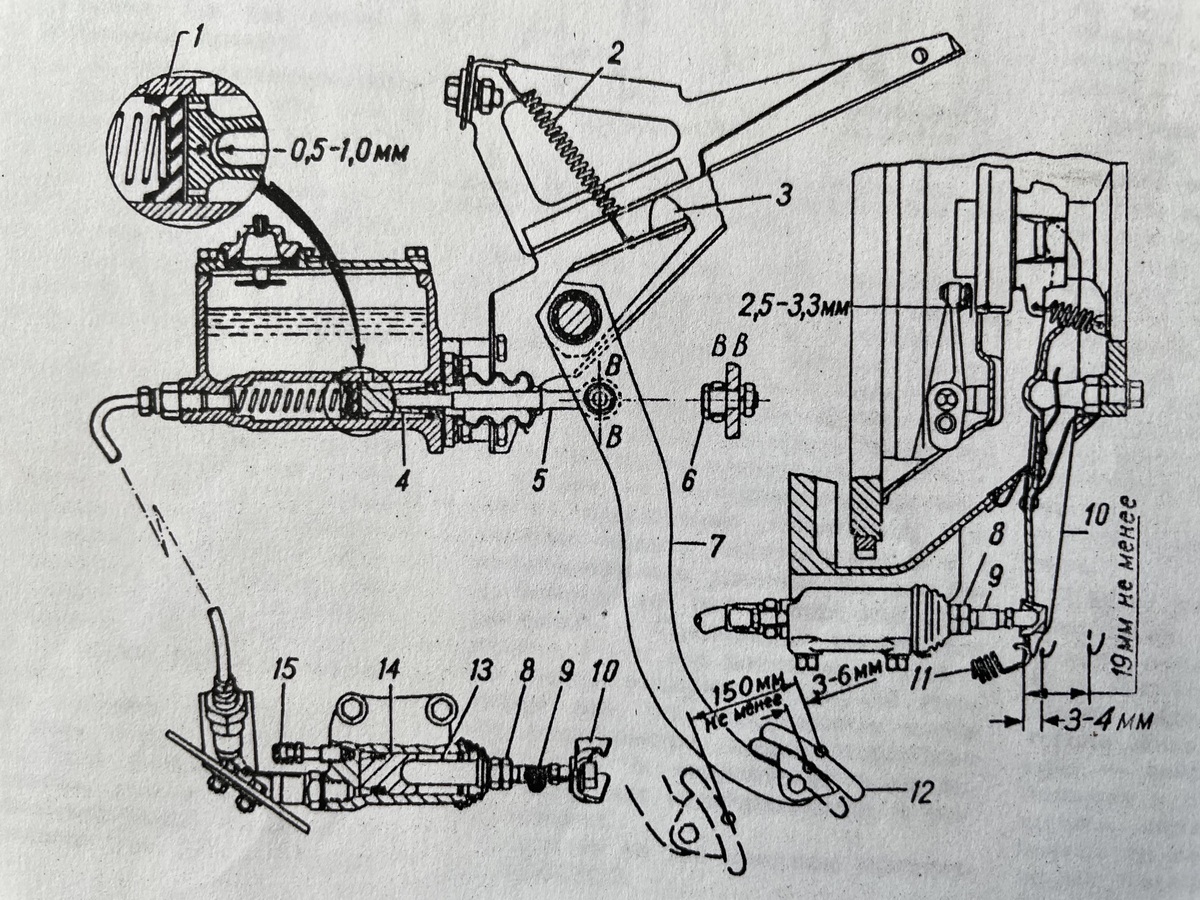
Adjusting a hydraulic drive differs significantly from adjusting a mechanical one. In a mechanical drive, pedal free play depends on the clearance between the release levers and the release bearing, as well as play in the connections. In a hydraulic drive, there is additional pedal free play required to take up the clearance between the pushrod and the master cylinder piston, and for the piston to travel from its rest position to the point where the seal lip clears the bypass port.
It should be kept in mind that free play varies across different "Volga" car models. It is determined by the thoroughness of the system bleeding, its airtightness, and variations in parts within manufacturing tolerances.
Before adjusting, check the fluid level in the master cylinder. If you suspect there is air in the system (leaks at connections, increased pedal free play), bleed the drive.
Before adjusting the free play of the outer end of the fork, disconnect the return spring, place a ruler along the pushrod, and measure the free play by rocking the fork by hand. If it is not within 3–4 mm, loosen the locknut and change the length of the pushrod by rotating it. Hold the pushrod tip with a second wrench to prevent it from turning. Tighten the locknut and recheck the free play of the outer end of the fork. Reattach the fork return spring.
It is very convenient to use a ruler with a sliding metal marker for measurements. Before adjusting the clearance between the pushrod and the master cylinder piston, determine its current value. To do this, lightly press the clutch pedal pad down and forward (after removing the return spring) until the pushrod hits the piston, then release. If clearance is felt, determine its value using a ruler by the movement of the center of the pedal pad. This should be 3–6 mm at the pad center, which corresponds to a 0.5–1.0 mm clearance between the pushrod and the piston in the master cylinder. If the clearance is not within these limits or is not felt, check the pedal movement and ensure it rotates easily on its axis.
If the eccentric pin sticks in the rod hole, clean the edges of the plastic bushings and ensure the rod rotates freely after tightening the eccentric pin. However, if the pedal rotates easily but the pad movement is less than 3 mm or more than 6 mm, loosen the eccentric pin nut and rotate the pin to establish the normal clearance.
The side of the eccentric head marked "O" corresponds to its low side. Rotating the head clockwise decreases the clearance. If rotating the eccentric does not increase the pedal travel, the stop buffer can be trimmed or its bracket bent.
After performing both adjustments described above, check the total clutch pedal free play. It should be 32–40 mm. If the value is less, either the adjustments were performed incorrectly or the bypass port in the master cylinder is blocked.
The latter can be easily verified by inserting a blunt-ended copper wire (0.6 mm diameter) through the master cylinder reservoir filler hole. Blockage can occur due to the seal swelling from low-quality fluid. The port may also be contaminated. Once these causes are eliminated, achieve the correct adjustment. Before adjusting the total travel of the fork, measure it with a ruler during clutch disengagement. It should be at least 19 mm. If it is less, check the total travel of the pedal pad. To do this, press the pedal to the floor mat and place the end of a ruler against the mat next to the center of the pedal pad. Note the reading on the ruler at the pad level. Without moving the end of the ruler, release the pedal. Place the top of the ruler against the same spot on the center of the pad and record the reading again. The difference will be the total pedal travel. It is convenient to use a ruler with a slider for these measurements. If the travel is too small, the rubber buffer can be trimmed as mentioned above to obtain the required value of 150 mm. Reducing the buffer height by 1 mm increases pedal travel by 3.5 mm.
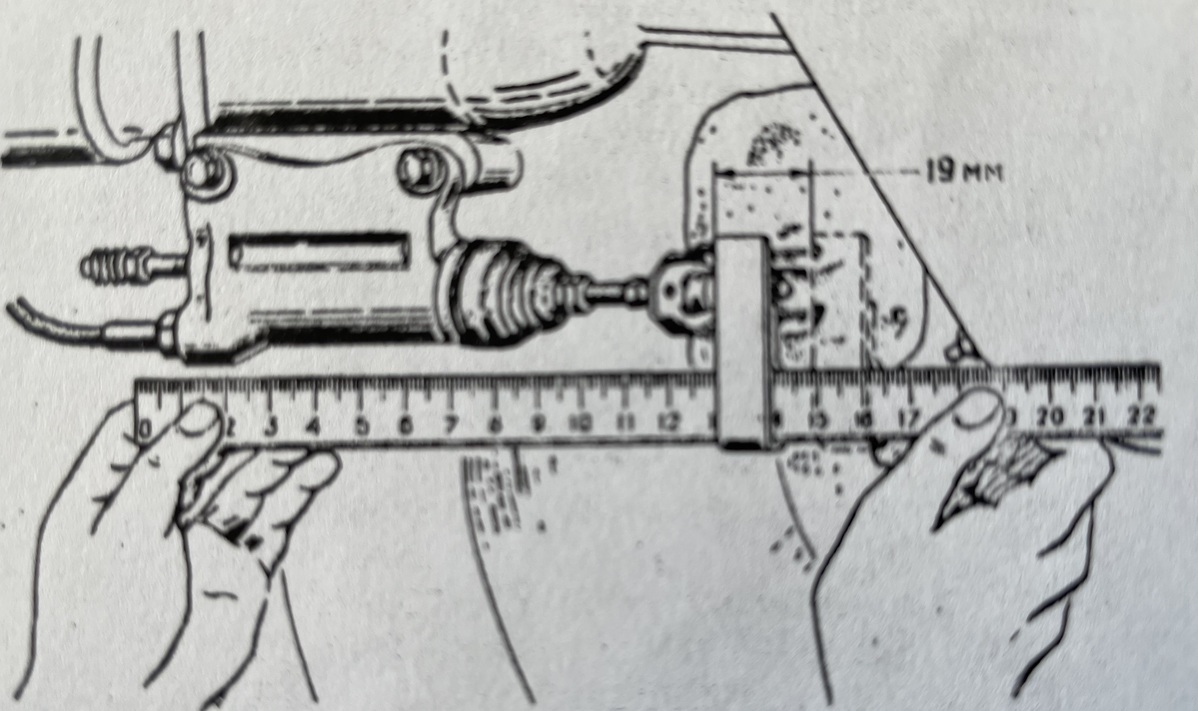
Instead of trimming, the clutch pedal can be lifted by hand so that the bracket where the buffer is attached bends slightly downward. After this, the clearance between the pushrod and the master cylinder piston must be readjusted. If the total pedal travel is at least 150 mm, but the total travel of the outer end of the fork is still less than 19 mm, it is likely that the system has not been bled properly and contains air.
Carefully inspect the hose, its connections, the fittings, and the areas where the cylinder rods exit. If you find a leak, repair it. If there is no leak, thoroughly bleed the system again until the travel reaches 19 mm. A swollen seal blocking the port or a clog in the master cylinder orifice can also reduce fork travel. However, sometimes the required travel is not achieved even after bleeding.
In that case, with the slave cylinder bleed valve closed, use a tire pump to apply several strokes of pressure to the master cylinder and measure the fork travel again.
